

kamisoriharnisch
Shobudani Namazu・Pierre de finition naturelle・Awasedo・Kyoto, Japon #103
Shobudani Namazu・Pierre de finition naturelle・Awasedo・Kyoto, Japon #103
Stock bas
Impossible de charger la disponibilité du service de retrait
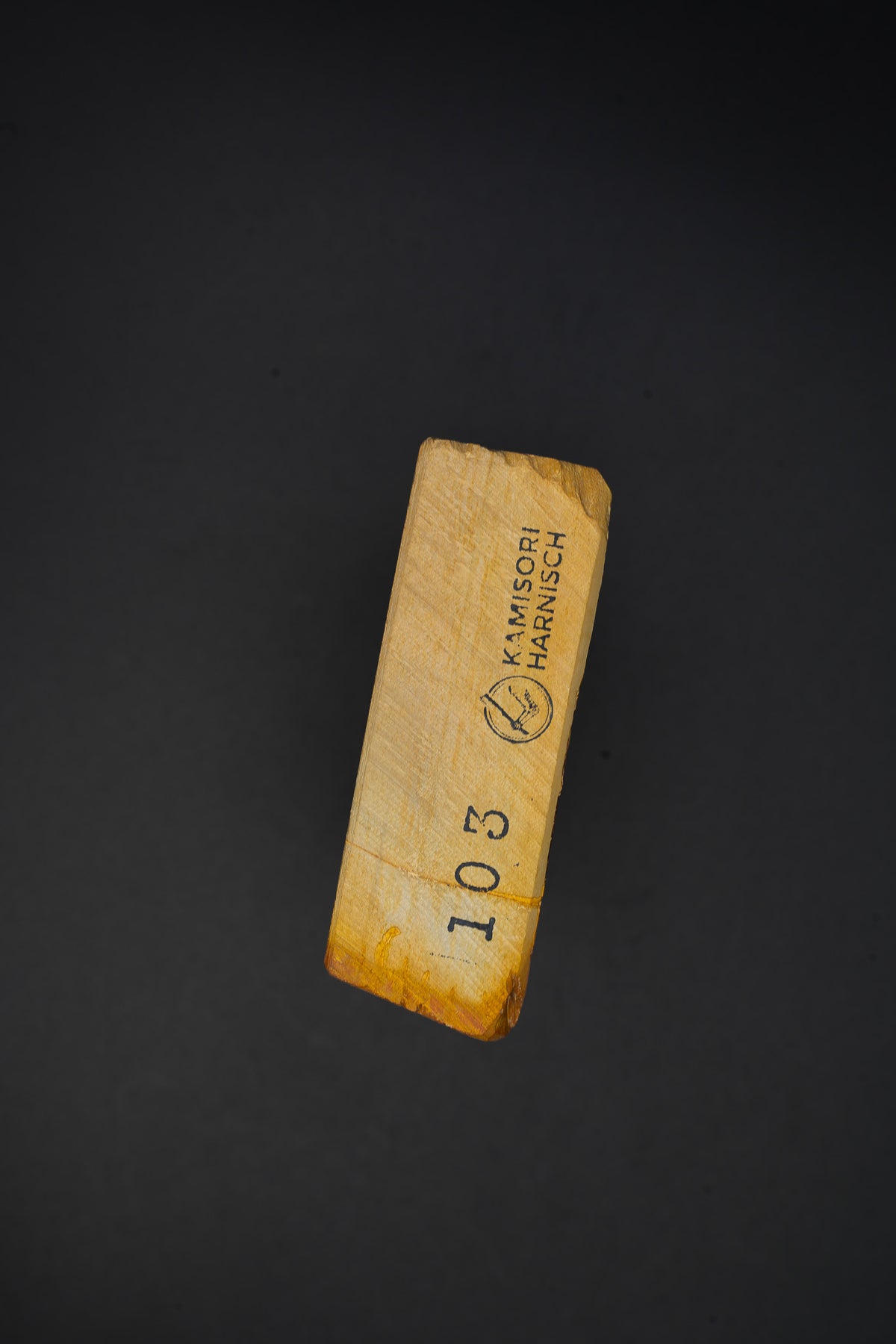
Shobudani de Kyoto, marquée 菖蒲産 — de Shōbu — sous le cachet des pierres naturelles de Kyoto.
La face présente un corps crème pâle portant des namazu, les marques de poisson-chat qui font la réputation de cette vallée, avec des plages gris-bleu et de fines lignes roses. Le revers est fortement teinté d’ocre et de fer, et un bord est scellé à l’urushi rouge.
3,5 sur 5 sur notre échelle de dureté, grain d’environ 8000. Shobudani offre un toucher plus doux et plus indulgent que les couches dures de Kyoto et libère volontiers sa boue — une pierre de finition patiente pour kamisori et rasoirs droits.
Livrée avec son tomo-nagura assorti, marqué 菖蒲谷産 — la boue provient de la même vallée, la manière traditionnelle de travailler cette pierre.
Vous recevrez exactement la pierre présentée.
Description complète
Description complète
This Shobudani natural finishing stone comes from the Shōbu valley in Kyoto, stamped 菖蒲産 under the Kyoto natural-stone mark. It carries namazu, the catfish markings the valley is known for, over a pale cream body. At 3,5 of 5 on our hardness scale it sits below the harder Kyoto layers: it releases slurry readily, cuts with a soft and forgiving feel, and finishes with a quiet kasumi rather than a bright mirror. That combination makes it a patient finisher for kamisori and straight razors, and a pleasant stone for single-bevel and carbon kitchen knives. It is supplied with its matching tomo-nagura from the same valley. You will receive the exact stone shown.
Matériaux
Matériaux
Natural Whetstone - Shobudani
Des mesures
Des mesures
Length: 15,0 cm
Width: 7,0 cm
Height: 2,5 cm
Weight: 711 g
Hardness: ● ● ● ◐ ○ (3,5/5) hard
Guide d'entretien
Guide d'entretien
Sharpening Care Guide — Natural Japanese Whetstones
To preserve the character, performance, and longevity of your natural Japanese whetstone, please follow these care guidelines:
1. Keep the Stone Flat
Natural stones wear more slowly than synthetic stones, but regular flattening is still essential for controlled sharpening. Use a diamond lapping plate or a suitable flattening stone to maintain a flat, even surface. Avoid aggressive lapping unless necessary.
2. Use Water Only
Natural Japanese whetstones are designed to be used with water. Lightly wet the surface before use. Some stones benefit from a brief pre-wetting, while others should not be soaked for extended periods. Do not use oil or chemical additives.
3. Slurry Management
Depending on the stone, slurry may develop naturally during use. This is part of the sharpening process and should be managed gently. Avoid excessive pressure or artificial slurry generation unless intentionally desired.
4. Clean After Use
After sharpening, rinse the stone thoroughly with clean water to remove metal particles and residue. Use a soft brush if needed. Do not use soap, detergents, or abrasive cleaners.
5. Dry Slowly and Naturally
Allow the stone to air dry completely in a shaded, well-ventilated area. Avoid direct sunlight, heaters, or rapid temperature changes, as natural stones can crack if dried too quickly.
6. Store with Care
Store the stone in a dry, stable environment. Avoid damp locations and protect the stone from impacts or sudden temperature changes. If stored long-term, ensure the stone is fully dry before placing it in a box or wrapping.
7. Inspect Before Use
Before each use, rinse the surface and ensure it is free from dust, grit, or foreign particles. Any contamination may cause scratches on the blade and compromise sharpening results.
By following these guidelines, your natural whetstone will retain its unique sharpening characteristics and provide consistent, controlled results over time.
Partager